Roundcube Plugin: identity_from_directory (maintain identities via LDAP)
Licensing
- Primary license: GPL-3.0-or-later
Miscellaneous
- Funding: Buy us a coffee
- Maintainer: foundata
- Status: Stable
README
Use LDAP or AD to maintain email identities.
A Roundcube plugin to populate and maintain a user’s email identities automatically on each login, based on corresponding LDAP or Active Directory data.
⭐ Found this useful? Support open-source and star this project:

Screenshots
A user with the following Active Directory data
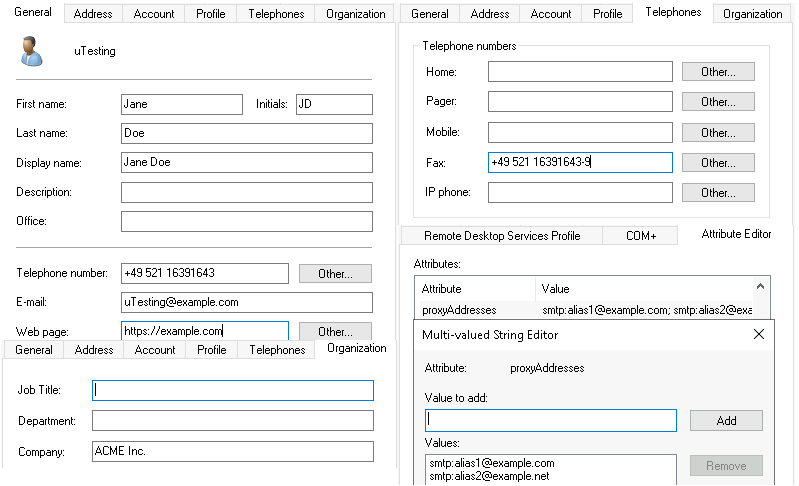
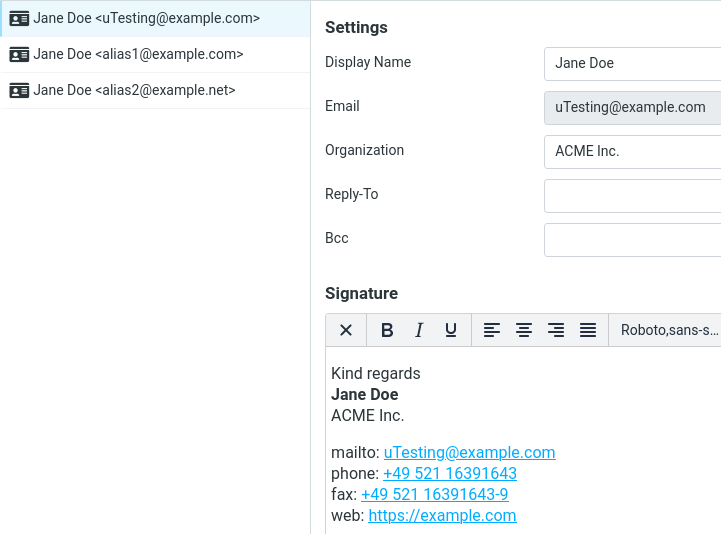
and a signature template set to
$config['identity_from_directory_signature_template_html'] = '
<p>
    Kind regards<br />
    <strong>%name_html%</strong><br />
    %organization_html%
</p>
<p>
    mailto: <a href="mailto:%email_url%">%email_html%</a><br />
    phone: <a href="tel:%phone_url%">%phone_html%</a><br />
    fax: <a href="tel:%fax_url%">%fax_html%</a><br />
    web: <a href="%website_url%">%website_html%</a>
</p>';
would result in the following Roundcube identities after the user login:
Installation
Installation using Composer
The following command installs the
plugin package
via Composer into
plugins/identity_from_directory:
php composer.phar require --update-no-dev -o "foundata/identity_from_directory:*"
If you want to use the current development version from Git, use
-o "foundata/identity_from_directory:dev-main". Please confirm with y when
Composer asks you whether you want to enable the plugin in the Roundcube
configuration. Alternatively, add identity_from_directory to Roundcube’s
$config['plugins'] array by hand.
You can now configure the plugin.
Installation from release tarball
Download the latest
identity_from_directory-vX.Y.Z.tar.gz tarball
(do not use the “Source code” archives Github creates automatically for each
release). Extract it into plugins/, all files have to be in
plugins/identity_from_directory/ afterwards.
Useful snippet if you have got a shell available on your target server:
## set Rouncube's installation path, adapt if needed
roundcube_install_dir="/var/lib/roundcube"

## get version number of the latest release
version="$(curl -s -L https://api.github.com/repos/foundata/roundcube-plugin-identity-from-directory/releases/latest | jq -r '.tag_name' | sed -e 's/^v//g')"
printf '%s\n' "${version}"

## download
curl -L "https://github.com/foundata/roundcube-plugin-identity-from-directory/releases/download/v${version}/identity_from_directory-v${version}.tar.gz" \
  > "/tmp/identity_from_directory.tar.gz"

## extract and cleanup
cd "${roundcube_install_dir}/plugins" && tar -xzvf "/tmp/identity_from_directory.tar.gz" && rm "/tmp/identity_from_directory.tar.gz"
Configure the plugin and add identity_from_directory to
Roundcube’s $config['plugins'] array to enable it.
Updating
Update using Composer
The following command updates the plugin package via Composer:
php composer.phar update --no-dev -o "foundata/identity_from_directory:*"`
Update from release tarball
Updating is as simple as overwriting the existing files. Just follow the installation instructions again to get the newest release. This should be a low-risk operation as there are no database schema changes performed by this plugin and this project adheres to Semantic Versioning. The changelog will inform you of any manual actions required during an upgrade, typically only necessary for major version increments.
Configuration
- Copy the template
config.inc.php.disttoconfig.inc.php(Composer may already have done this for you) - Now edit
plugins/identity_from_directory/config.inc.phpas you need. The inline comments describe every config value in detail.
Some additional notes:
- All plugin actions are only triggered during a user’s login. So logout and login again to test a new configuration.
- This plugin is technically
compatible with all values of Roundcube’s
$config['identities_level']config option. However, a value of1(user can edit all params but not the email address as well as add or delete identities in the UI) or3(user can edit all params but not the email address and cannot add or delete identities in the UI) makes most sense. - Set
$config['identity_from_directory_deleteunmanaged'] = trueif you want to delete propably unwanted identities automatically. - Set
$config['identity_from_directory_handle_proxyaddresses'] = trueto support searching for alias addresses in Active Directory’sproxyAddressesfield. It may contain a CSV string likesmtp:foo@exmaple.com,smtp:bar@example.net.
Compatibility
- Roundcube 1.6 or higher.
- PHP 7.4 or higher.
- No special database requirements. This plugin does not adapt the database schema and is using Roundcube’s built-in actions and hooks to handle the identity data.
The plugin may work with older versions then listed above, but this is not tested nor supported. We recommend using the latest stable Roundcube version and PHP 8.x, which the plugin is most tested with.
Licensing, copyright
Copyright (c) 2024-2026, foundata GmbH (https://foundata.com)
This project is licensed under the GNU General Public License v3.0 or later
(SPDX-License-Identifier: GPL-3.0-or-later), see
LICENSES/GPL-3.0-or-later.txt for the full
text.
The REUSE.toml file provides detailed licensing and copyright
information in a human- and machine-readable format. This includes parts that
may be subject to different licensing or usage terms, such as third-party
components. The repository conforms to the
REUSE specification. You can use
reuse spdx to create
a
SPDX software bill of materials (SBOM).
Trademarks
Third-party trademarks used in this repository:
- Active Directory® is a trademark of Microsoft Corporation, registered in the European Union and the United States.
- Roundcube® is a trademark of Innovento GmbH, owned by Nextcloud CEO Frank Karlitschek, registered in the European Union.
Their use here is purely descriptive and does not imply any affiliation with or endorsement by the trademark holders.
Own and licensed trademarks used in this repository:
- foundata® is a trademark of IPAM GmbH, registered in Germany and the European Union, licensed to foundata GmbH.
Author information
This project was created and is maintained
by foundata. If you like it, you might
buy them a coffee.
The plugin was heavily inspired by the
new_user_identity plugin.