ScanMole
Lizenzierung
- Primäre Lizenz: GPL-3.0-or-later
Sonstiges
- Spenden: Buy us a coffee
- Projektbetreuer: foundata
- Status: Stabil
Dieses Projekt nutzt eine andere Arbeitssprache als Deutsch. Der folgende Abschnitt wurde automatisch aus der README-Datei generiert und liegt daher nur in der Originalsprache vor.
README
Easy, scriptable document scanning for Linux: ADF duplex batches in, searchable (OCRed) PDFs out.
The focus is everyday office and archival paperwork such as letters, invoices, contracts, receipts and records, not photo or image scanning: the defaults trade color fidelity for small, legible, searchable documents that keep well in an archive.
It consists of two components, shipped as two Python packages, so servers and scripts can install the CLI alone while desktops get the whole experience:
scanmole: CLI scanning engine.scanmole-gui: GTK4/libadwaita frontend (depends onscanmole). A thin subprocess wrapper around the CLI using its--jsonevent protocol; it contains no scanning logic itself.

⭐ Found this useful? Support open-source and star this project:

Features
Main features:
- Automation-grade CLI with defined exit codes, filename templates and a versioned JSON event protocol.
- Easy-to-use GTK4/libadwaita GUI on top of the same engine.
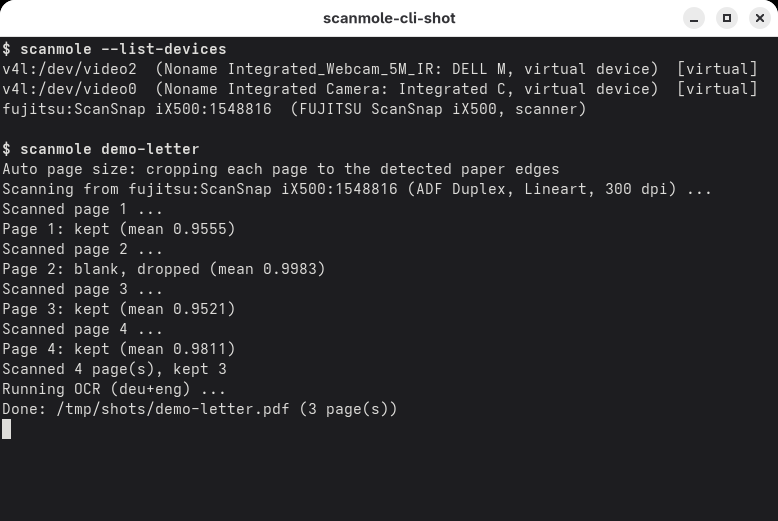
- Scan a stack of paper into one searchable PDF with a single command: duplex batch, blank backsides dropped, OCR text layer, archival PDF/A output by default.
- Automatic page size detection crops every page to the detected paper edges, falling back to conservative framing around the printed content where a device hides the paper boundary, so receipts come out receipt-sized and mixed stacks need no set-up.
- Small files by default: 1-bit black-and-white at 300 dpi lands at roughly 100 KB per A4 text page or less.
- Skewed pages are straightened by ScanMole itself, so deskew does not
depend on the driver offering it: the angle is measured and the raster rotated
before the PDF is built.
--deskew-method scannerhands the job to the device instead where you trust its own correction if needed. - Works with anything
SANE can drive,
including driverless eSCL devices via
sane-airscan. Device capabilities are probed and mapped instead of hardcoded, and devices without a native 1-bit mode get software binarization automatically.
Demo
Screenshots
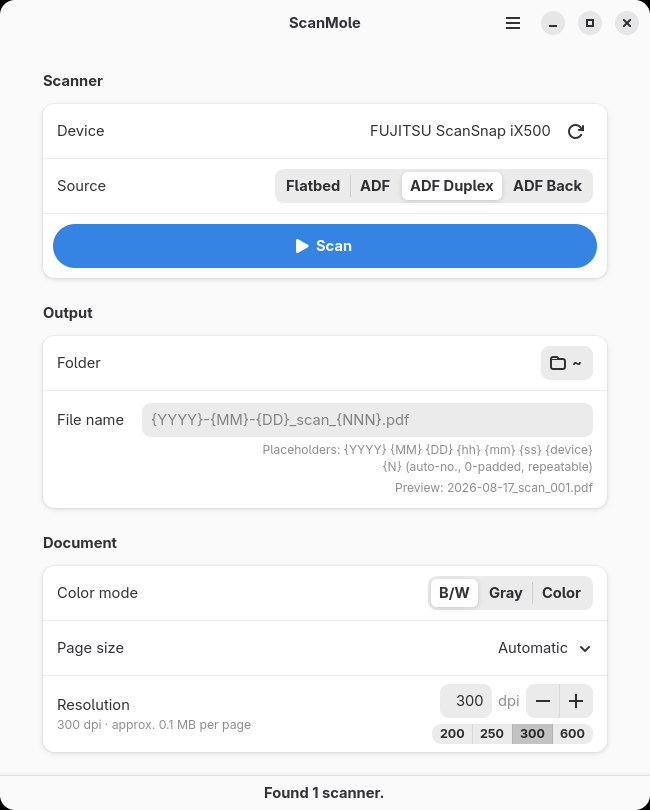
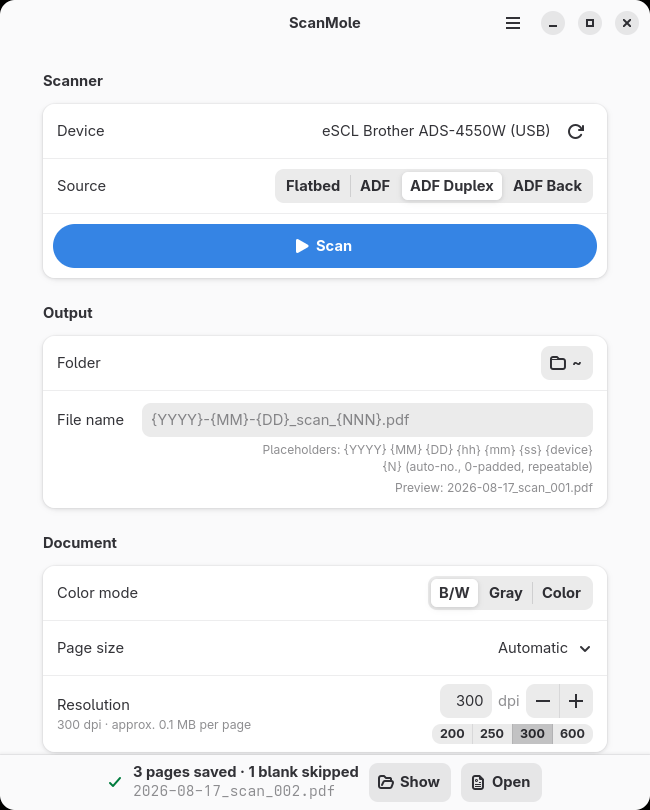
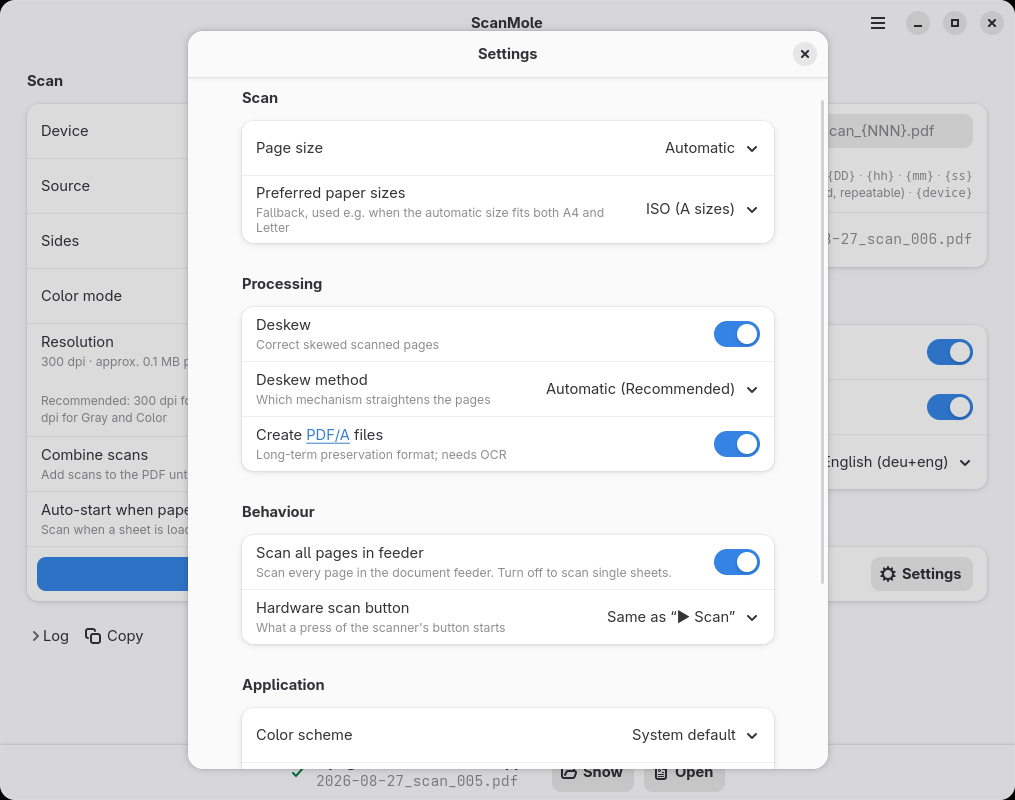
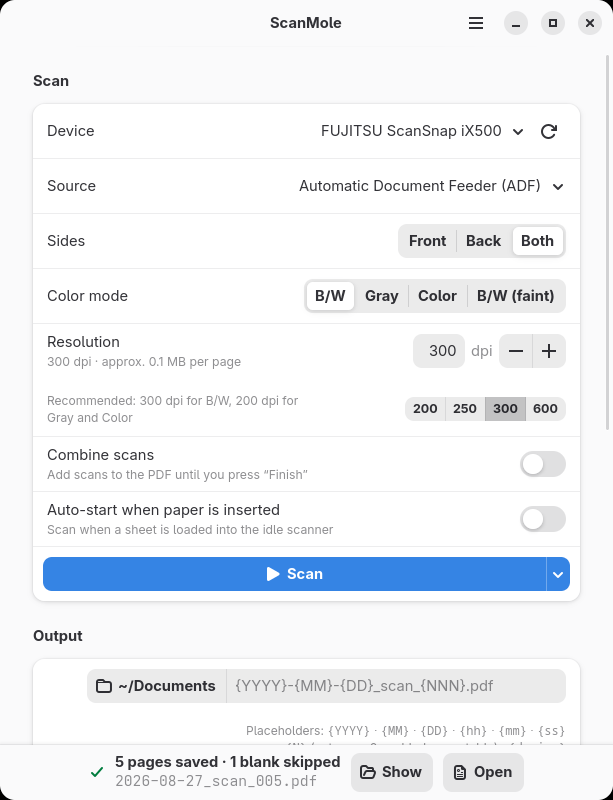
Example PDF
A real, unedited result:
scanmole-demo-scan-bw-300dpi-ix500.pdf
(3 pages, 197 KB total, so about 66 KB per page): a ScanSnap iX500 duplex batch
of a few pages printed from
scripts/scanner-evidence/print-pack.ps,
scanned at the 1-bit black-and-white, 300 dpi defaults and OCRed, giving an
impression of both the typical file size and the searchable text layer.
Installation


ScanMole needs Python ≥ 3.12. Its two packages are available on PyPI:
scanmole (the CLI) and
scanmole-gui (the desktop frontend,
pulls the CLI automatically).
Install them as managed applications with
pipx: it keeps each package in an
environment of its own, puts the commands on PATH, and needs no virtualenv to
be created or activated by hand.
Desktop (CLI + GUI): the GUI uses the distribution’s PyGObject/GTK (see the packages below) instead of a PyPI build, so its environment has to see the system site packages:
pipx install --system-site-packages --include-deps scanmole-gui
--include-deps also puts the dependency’s scanmole command on PATH, so
both the CLI and GUI are available from your shell.
uv is not an option here: uv tool install has no --system-site-packages
equivalent, so a GUI installed with it cannot reach the distribution’s PyGObject
and GTK. Hence the pipx recommendation.
Tip: after the first scanmole-gui start, the settings dialog can install a
menu entry, so later starts come straight from the desktop’s application grid.
Server or scripting (CLI only): the CLI carries one Python dependency (Pillow, for raster rotation) and needs nothing from the distribution’s Python:
pipx install scanmole
For development installs from a repository checkout, see
DEVELOPMENT.md.
ScanMole’s runtime shells out to external tools, which come from distribution packages. Install them as follows (on a CLI-only machine, the GTK/PyGObject packages at the end of each list can be skipped):
Debian/Ubuntu
Only Debian 13+ and Ubuntu 24.04+ are supported (older releases lack the required Python ≥ 3.12):
sudo apt install sane-utils sane-airscan img2pdf ocrmypdf \
                 tesseract-ocr tesseract-ocr-deu tesseract-ocr-osd jbig2enc \
                 python3-gi gir1.2-gtk-4.0 gir1.2-adw-1
Fedora
sudo dnf install sane-backends sane-airscan img2pdf ocrmypdf \
                 tesseract tesseract-langpack-deu tesseract-osd \
                 python3-gobject gtk4 libadwaita
For smaller PDFs, it is highly recommended to also install jbig2enc (ocrmypdf
picks it up automatically). Fedora does not package it (last checked: Fedora 44,
2026-Q3; a leftover of the long-expired JBIG2 encoding patents), so build it
from source:
sudo dnf install gcc-c++ automake libtool leptonica-devel zlib-devel
git clone https://github.com/agl/jbig2enc.git /tmp/jbig2enc
cd /tmp/jbig2enc
./autogen.sh && ./configure && make
sudo make install   # installs the jbig2 binary under /usr/local/bin
Updating works the same way; the leading line reuses the clone when it still
exists and starts fresh otherwise (/tmp does not survive a reboot):
git -C /tmp/jbig2enc pull || git clone https://github.com/agl/jbig2enc.git /tmp/jbig2enc
cd /tmp/jbig2enc
./autogen.sh && ./configure && make
sudo make install
Device-specific packages, network configuration and the list of verified units are collected under Devices.
Updating
Both packages always release together and carry the same version, and a newer GUI refuses an older engine, so updating the frontend pulls the matching CLI with it:
pipx upgrade scanmole-gui   # desktop (GUI and CLI)
pipx upgrade scanmole       # CLI only
The external tools come from the distribution and update with it; only a
self-built jbig2enc needs the rebuild shown above. To
check what is actually running, use scanmole --version, or open “About
ScanMole” from the GUI’s main menu, which names the engine and the frontend
separately.
Usage
Command Line Interface (CLI)
scanmole --list-devices   # what SANE sees (webcams/v4l are ignored)
scanmole                  # ADF duplex, lineart, 300 dpi, auto size, deu+eng OCR
                          #   -> ./2026-08-15_scan_001.pdf (auto-numbered)
scanmole '{YYYY}-{MM}_scan_{NN}'  # template -> ./2026-08_scan_01.pdf
scanmole -o invoice.pdf --mode gray -r 300 -l deu+eng
scanmole --source flatbed --no-ocr --keep-blanks draft
scanmole --from-images pages/*.png -o rebuild.pdf  # pipeline without a scanner
Output names may contain placeholders, in the CLI and the GUI alike: {YYYY},
{MM}, {DD} (date), {hh}, {mm}, {ss} (time), {N}/{NN}/…
(zero-padded auto-increment, bumped until the name is free) and {device}; the
default is {YYYY}-{MM}-{DD}_scan_{NNN}.pdf.
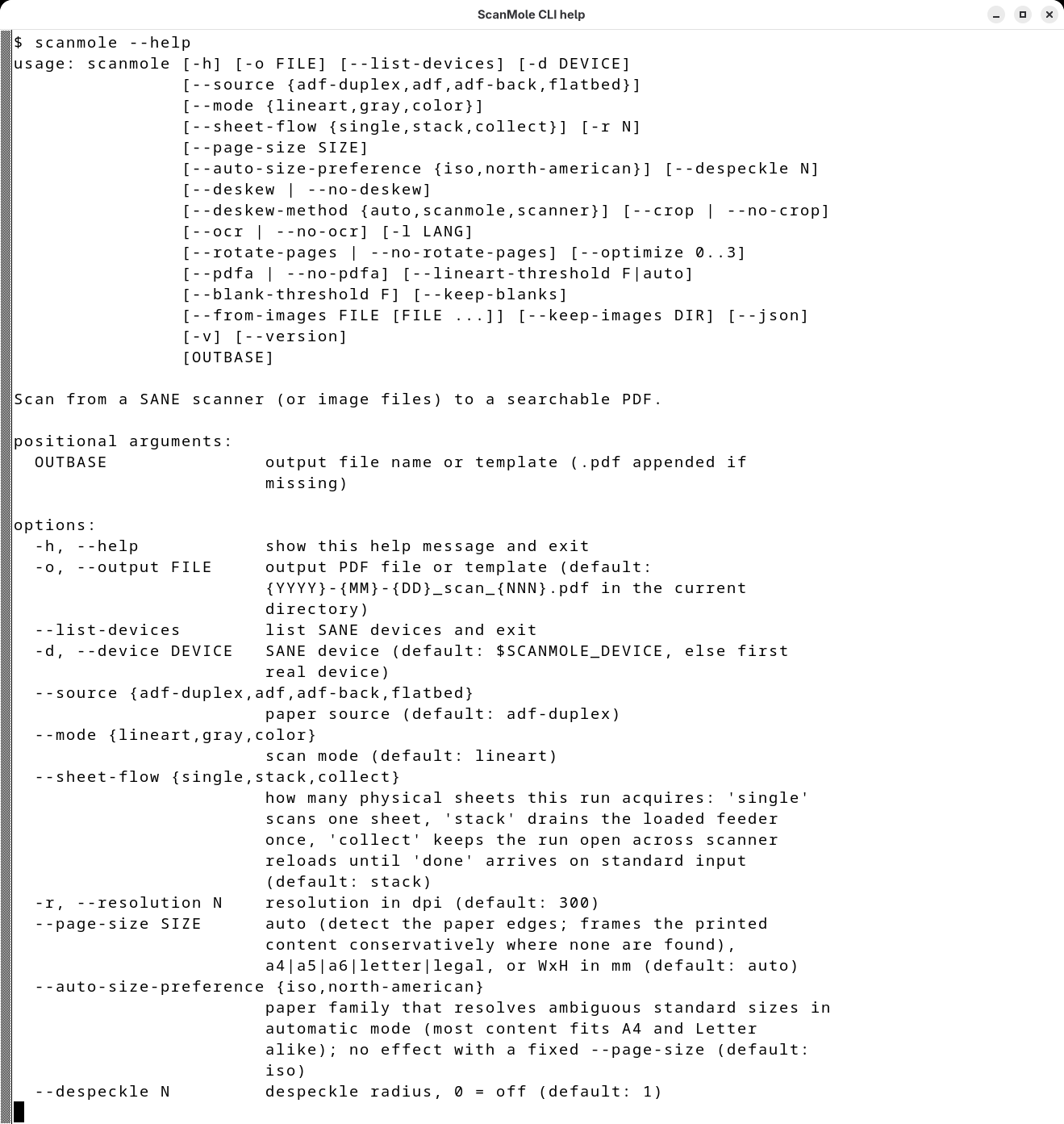
Run scanmole --help for the full list of options. Common examples:
scanmole -r 300 'contract_{YYYY}-{MM}-{DD}_{NN}'  # higher dpi for small print
scanmole --source adf --keep-blanks               # single-sided stack, keep every page
scanmole --mode gray -l deu --no-pdfa notes       # grayscale, German-only OCR, plain PDF
scanmole --keep-images /tmp/pages -v receipts     # keep page images, verbose log
scanmole --sheet-flow single                      # exactly one sheet, rest stays in the tray
scanmole --sheet-flow collect                     # one PDF across reloads; finish with "done"
--sheet-flow controls how many physical sheets one run acquires. The default
stack drains the loaded feeder once, single scans exactly one sheet (both
sides on a duplex source) and leaves the rest in the tray, and collect keeps
the run open across reloads: insert the next sheet (single-sheet feeders like
the ScanSnap iX100 continue automatically, and the scanner’s own button works
too), or type next for flatbeds, and type done to build the PDF. A collect
run that waits more than 15 minutes finishes on its own with the sheets it has.
What if my scanner acts up, for example wrong page sizes in auto mode,
surviving blank pages, or a badly mapped mode? Every device behaves a little
differently at the edges of a scan, and we can usually fix it from a few
captured files alone: see
reporting scanner problems and device quirks
for exactly what to include.
The GUI
Start the GUI with the command pipx put on PATH:
scanmole-gui
The settings dialog can install a menu entry (.desktop file) for your user, so
later starts work straight from the desktop’s application grid.
scanmole-gui is a form over the same engine with the same defaults. The GUI
remembers the last used form values and the window size in
~/.config/scanmole/gui.json and restores them on the next start.
Scan a document
Press Scan to start a batch. The button turns into Cancel while the batch runs; press it to stop scanning. When the scan finishes, use the result bar to open the PDF or its folder. Expand the collapsible log to see the underlying CLI output.
Combine sheets into one PDF
- Turn on “Combine scans”, or pick “Combine scans” from the button’s menu for one run.
- Press Scan. On a scanner that can sense loaded paper, the run waits until a sheet is present; otherwise, it acquires the first sheet straight away.
- Insert the remaining sheets, then choose Finish to build the one PDF.
Scan one sheet from a feeder
Choose “Scan one sheet” from the Scan menu for one run. To make that the normal behavior, turn off “Combine scans” and turn off “Scan all pages in feeder” in Advanced settings. “Combine scans” takes precedence when enabled. “Scan all pages in feeder” applies only to feeder sources. Both sides are scanned on a duplex source, and the rest of a loaded stack stays in the tray.
Start from the scanner
In Advanced settings, choose what the scanner’s hardware button does while the window is idle: repeat the Scan button’s action (the default), scan one sheet, collect sheets, or do nothing.
“Auto-start when paper is inserted” starts a scan when a sheet is loaded; it is off by default. Both triggers require the corresponding scanner sensors.
Exit codes
| Code | Meaning |
|---|---|
0 | Success: PDF written. |
1 | Unexpected internal error. |
2 | Usage or input error: bad arguments, invalid page size, conflicting options. No PDF was produced. |
3 | Acquisition failure: scanimage failed, no usable device, device vanished mid-batch, or a device probe timed out. |
4 | Missing external tool: scanimage, img2pdf, ocrmypdf or tesseract is not installed. --deskew needs tesseract whenever ScanMole straightens the pages itself, which is the default on every device, including one whose driver offers a deskew option; only a run the scanner’s own mechanism owns (--deskew-method scanner, or a correction that cannot be switched off) goes without it. |
5 | Processing failure after successful acquisition: img2pdf or ocrmypdf failed, or a page could not be measured or straightened. Scanned pages are preserved in the work directory (path in the error message), so the batch can be rebuilt with --from-images instead of rescanning the paper. |
6 | Nothing to scan: feeder empty, or every page was blank. Not a malfunction; no PDF was produced. |
130 | Interrupted (SIGINT). |
143 | Terminated (SIGTERM), e.g. a GUI cancel. |
The --json protocol
One JSON object per line on stdout; human-readable log on stderr. Selected event examples (not a transcript of one run):
{"event":"hello","version":"1.0.0"}
{"event":"devices","devices":[{"device":"...","vendor":"...","model":"...","type":"..."}]}
{"event":"start","device":"...","source":"adf-duplex","mode":"lineart","resolution":300,"page_size":"a4","output":"..."}
{"event":"settings","device":"...","source":"ADF Duplex","mode":"Lineart","resolution":300}
{"event":"page","n":1,"file":"...","blank":false,"mean":0.87}
{"event":"scan_done","total":5,"kept":4,"blanks":1}
{"event":"ocr_start","lang":"deu"}
{"event":"done","output":"out.pdf","pages":4,"bytes":812345,"seconds":41.2}
{"event":"error","message":"...","code":3}
hello is the first event of every --json run that emits events.
Argument-parsing errors exit before any event is written. devices is emitted
only for --list-devices; a successful scan ends with done, and a failure is
reported with error.
hello carries the CLI version, which is also the API version
(SemVer). From 1.0.0 on compatibility is directional
inside a major: a frontend may drive its own or any newer CLI of that major, but
not an older one, since it emits options and expects behavior the older CLI does
not have. Majors never mix, and before 1.0.0 the versions have to match exactly.
start carries the requested settings; settings (scanner runs only) reports
the values actually negotiated with the SANE backend. error.code mirrors the
process exit code. This protocol, the option names and the exit codes are the
compatibility boundary for any frontend or reimplementation; the authoritative
definition is the CLI contract in
ARCHITECTURE.md.
Devices
Anything SANE can drive should work without ScanMole knowing the model; vendor specifics and the verified units are collected here.
Brother
Modern Brother devices (e.g. the Brother ADS-4550W) work driverless via
sane-airscan (eSCL) and need no additional packages or configuration beyond
the dependencies from Installation.
Older devices without eSCL support (e.g. the Brother ADS-2600W) need Brother’s
proprietary brscan4/brscan5 driver packages from the
Brother support site;
network devices must additionally be registered with
brsaneconfig4/brsaneconfig5.
Epson
Modern Epson document scanners (DS/ES/WorkForce series, e.g. the Epson DS-730N)
use the epsonds backend. If your device is not recognized, try one of the
following; epsonds does no discovery over the network:
Add a line
net <ip-address>to/etc/sane.d/epsonds.conf; the device then appears asepsonds:net:....Alternatively these devices speak WSD via
sane-airscan. If discovery does not pick the scanner up, pin the endpoint in the[devices]section of/etc/sane.d/airscan.conf, copying the lineairscan-discoverreports.[devices] "<device name, e.g. EPSON DS-730N>" = http://<ip-address>:80/WDP/SCAN, WSD
Do not use an epson2:net:... entry that may show up alongside: the
epson2 backend covers older flatbeds and misdetects DS models over the network
(as a flatbed named “PID”, failing with an I/O error at scan start).
ScanSnap
ScanSnap devices (e.g. the ScanSnap iX500; formerly sold under the Fujitsu
brand, Ricoh products today) use the stock SANE fujitsu backend over USB. They
need no additional packages or configuration beyond the dependencies from
Installation.
Tested devices
The following devices are regularly used with ScanMole and were verified with real batches:
| Device | Connection | SANE backend | Notes | Known limitations |
|---|---|---|---|---|
| Brother ADS-4550W | USB (via ipp-usb) and network | airscan (eSCL, driverless) | Duplex ADF. Offers only Color/Gray, so 1-bit output comes from ScanMole’s software conversion, and it exposes no deskew option, so ScanMole always straightens pages itself. | None known. |
| Canon CanoScan LiDE 220 | USB | genesys | Flatbed. Feeder requests degrade to a single flatbed scan; 1-bit output comes from ScanMole’s software conversion. | None known. |
| Epson DS-730N | Network | epsonds (see Epson) | Duplex ADF, native 1-bit. | Ignores its hardware auto-crop command over the network; ScanMole’s auto page size compensates by sizing each page from its content. |
| ScanSnap iX100 | USB | fujitsu | Portable single-side sheet feeder, native 1-bit. A duplex request degrades to the front side with a warning. | Its native 1-bit output leaves no brightness to walk, so automatic page size follows the ink instead and the edge-crop caveats then apply to all four edges rather than only the sides. An A4 feed comes out about 209 x 295 mm, correctly cropped from the 219 mm scan window. |
| ScanSnap iX500 | USB | fujitsu | Duplex ADF, native 1-bit, hardware paper-edge detection. | Native 1-bit puts automatic page size on the same ink path as the iX100, with the same edge-crop caveats. Its own --swdeskew was measured removing only about 15% of a hand-fed skew, so it stays unqualified and ScanMole straightens pages itself; --deskew-method scanner is not recommended here. |
Every listed device has its captured capability listing pinned in the test suite
(tests/fixtures/scanimage-A/), so its option mapping stays regression-tested
without the hardware. If your device works too (or does not),
reporting it helps this list grow.
FAQ
What to do if my scanner is not listed?
If a USB scanner does not show up in scanimage -L:
- Check that the needed packages are installed (see
Installation):
sane-backendsprovidesscanimageandsane-find-scanner,sane-airscanprovides the driverless eSCL route andairscan-discover,usbutilsprovideslsusb. - Check
lsusb. If the scanner is missing there too, the problem is cabling, power or the USB port, not software. - Run
sane-find-scanner -q. It talks raw USB without any backend; if it finds the device whilescanimage -Lstays empty, the cause is permissions or a disabled backend. - Permissions: SANE grants access to locally logged-in desktop users. After the
first plug-in, replug the device and log out and in once so the udev ACLs
apply. Over ssh or headless there is no desktop session (“works locally,
fails over ssh”); that needs a udev rule granting access to a
scannergroup. - Check
/etc/sane.d/dll.conf: the line for your vendor’s backend must not be commented out (Canonpixma/canon_dr, Epsonepsonds/epson2, ScanSnapfujitsu; the backend keeps its historic name). - Network-capable devices from roughly 2015 on usually speak eSCL and work
driverless via
sane-airscan: make sureavahi-daemonis running and check whatairscan-discoverfinds. Worth trying even when a device’s USB route fails. - Vendor drivers (Canon
scangearmp2, Epsonepsonscan2, Brotherbrscan4/brscan5) are the last resort for devices without an in-tree backend or eSCL support.
What to do if my scanner isn’t working as expected?
See
CONTRIBUTING.md: Report scanner problems and device quirks.
How can I optimize the PDF file size?
The defaults are already tuned for small files: 1-bit black-and-white (lineart) at 300 dpi compresses losslessly to roughly 100 KB per A4 text page. Devices without a native 1-bit mode need no special handling; ScanMole converts their gray output in software automatically.
To keep files small:
- Stay with the 300 dpi black-and-white default for usual documents. Use
--mode grayor--mode coloronly when a document really needs it (photos, stamps, faint or colored originals): they store 8 or 24 bits per pixel instead of 1, and sizes explode. The same goes for resolutions above 300 dpi, since data grows quadratically with dpi. For wholly faint originals such as thermal-paper receipts or washed-out copies, the GUI’s “B/W (faint)” mode (CLI:--lineart-threshold auto) keeps the small 1-bit output; it applies one guarded threshold per page, so a page mixing normal print with a much fainter region can still lose the faint part, and Gray remains the reliable choice for those. - Use
-r 200for documents where quality matters less; it roughly halves the data. Where no text layer is needed either,--no-ocrskips OCR entirely. - Highly recommended: make sure
jbig2encis installed. ocrmypdf detects it automatically during its optimization pass and recodes 1-bit pages losslessly to a fraction of their size.command -v jbig2shows whether it is present; if it prints nothing, follow the installation instructions. ScanMole says so too, but only where it would help: an OCR run over black and white pages logs one line about it, and the GUI notes it under the OCR switch and beside the finished file.
Why is a page missing from my PDF, or a blank page kept?
A page with content was dropped
Disable “Skip blank pages” in the GUI, or use --keep-blanks in the CLI, to
keep every page on the next scan. Blank pages are still counted.
Other options:
- Raise
--blank-thresholdtoward1to keep more sparse or faint pages while retaining blank-page detection. - Use
--blank-threshold 0to disable classification entirely.
Sparse or faint content can be mistaken for a blank page despite the detector’s additional content checks. Marks smaller than about 2.5 mm, solid filled blocks, lone full-width rules, and strokes too faint for the ink cutoff can fail those checks because they cannot reliably be distinguished from scanner artifacts. The blank-page detection explanation describes the threshold, measurement area, and content checks.
A blank page was kept
Try adjusting --blank-threshold; if tuning does not resolve the problem,
report the device quirk.
Punch holes, staple shadows, or a skewed scan showing the scan-bed edge can lower the measured brightness and make a blank page appear nonblank to the detector.
Why did automatic page size cut content near the edge?
Choose a fixed page size, such as --page-size a4 for A4 pages, or select the
size instead of “Automatic” in the GUI. Fixed sizes bypass automatic edge
detection.
Automatic sizing can mistake dense edge content for scanner backing:
- On gray/color scan images, dense content less than 2 mm from a side edge, with only a thin white margin before it, may be cropped. This limitation affects the side edges.
- On native black-and-white scans, dense content, a printed border, or a barcode spanning most of an edge can be removed, along with content touching that border. All four edges can be affected.
Localized marks surrounded by paper are normally retained. See automatic page sizing for the detection rules and their limits.
Contributing
See CONTRIBUTING.md for how to report issues and submit
changes. Translations are welcome.
This project’s functionality is mature, so there might be little activity on the repository in the future. Don’t get fooled by this, the project is under active maintenance and used on a daily basis by the maintainers.
Licensing, copyright
Copyright (c) 2025, 2026, foundata GmbH (https://foundata.com)
This project is licensed under the GNU General Public License v3.0 or later
(SPDX-License-Identifier: GPL-3.0-or-later), see
LICENSES/GPL-3.0-or-later.txt for the full
text.
The REUSE.toml file provides detailed licensing and copyright
information in a human- and machine-readable format. This includes parts that
may be subject to different licensing or usage terms, such as third-party
components. The repository conforms to the
REUSE specification. You can use
reuse spdx to create
a SPDX software bill of materials (SBOM).
Trademarks
- ScanSnap is a trademark of PFU Limited, a Ricoh Group company (ScanSnap scanners were sold under the Fujitsu brand until 2023)
- Fujitsu is a trademark of Fujitsu Limited
- Brother is a trademark of Brother Industries, Ltd
Their use here is purely descriptive and does not imply any affiliation with or endorsement by the trademark holders.